Monday, November 11, 2013

Veteran's Day 2013: Remembering the USS Indianapolis

Last Thursday night at a DAR meeting, I had the privilege of hearing Edgar Harrell speak about his WWII experience on the USS Indianapolis. This was an astounding tale, one full of nightmarish detail, horror, sadness, and bravery. All of these men aboard this ill fated ship are heroes.

Edgar Harrell, 7 November 2013

There were 1,196 men aboard the USS Indianapolis on the night of 30 July 1945 when it was sunk by a Japanese submarine. Approximately 300 men went down with the ship. One of the survivors who would live to tell the tale was Edgar Harrell, a farm boy from Kentucky. In 1943 at about the age of 19, Edgar signed up with the Marines. Upon seeing the USS Indianapolis, Edgar described it as a "floating city" and getting goose bumps when he saw the big guns.

After the USS Indianapolis delivered parts and uranium of Little Boy, the atomic bomb that would later be dropped on Hiroshima, the ship first made a stop in Guam and after proceeded toward the Phillippine islands. They would never make it. Somewhere over the Mariana Trench, the deepest part of the Pacific, the USS Indianapolis was torpedoed by a Japanese submarine commanded by Mochitsura Hashimoto. Within approximately 12 minutes it sunk. The men that didn't go down with the ship were surrounded by fires, oil, salt water, and the night sky.

There were few lifeboats and some of the men did not have time to put on their life jackets. Communications had been knocked out when the ship was hit, and the command to abandon ship was passed on from crew member to crew member verbally. Some of the men that survived were badly injured and would not make it through the night or the next day. All of the men were covered with oil from the ship, and some would struggle with the oil getting into their eyes. This oil combined with the salt water would irritate their eyes to blindness.

These men would spend the next 5 days and 4 nights trying to survive in the Pacific Ocean. To make matters worse there was little food if any, no drinking water, and sharks. The men huddled together in groups as best as they could. This did not prevent the sharks from attacking, although to stray from the group was an almost guarantee of being eaten by a shark. They also had life jackets that read "only good for 48 hours."

For the next 5 days the men would deal with hypothermia, shark attacks, dehydration, life jackets that no longer worked, few life boats, salt-water induced hallucinations, exhaustion from trying to stay afloat, and hunger. These men would watch their buddies become eaten by sharks, watch body parts of attacked buddies float to the surface, see other buddies drown, go crazy, succumb to wounds and exhaustion, or just generally give up.

Then on 2 August 1945, when they had realized that there were no rescue missions and were giving up hope, they were spotted. While on a routine patrol flight, co-pilot Lieutenant Wilbur "Chuck" Gwinn spotted Edgar and one other man that he was swimming with. This is a miracle in and of itself, that required so many details to line up exactly right. Just imagine for a moment flying high above the ocean and all you see for miles and miles is just water. You see the sun reflecting off of it here and there, little white caps breaking on the surface among the undulating motion of the sea. You are too high to see much in the way of specific little details, and besides you are only looking for enemy ships. Nothing else.

On this particular routine flight an antennae had become loose. Lt. Gwinn decided to try and fix it. He opened the bottom hatch, glanced down at the ocean far below for a brief second, and saw a reflection. Thinking it was the enemy he sounded the alarm. What he saw was the ship's oil reflecting off of Edgar and the other man's bodies. This was truly a miracle.

The survivors, 321 of them, would eventually be rescued and taken to hospitals. Some of these men would end up succumbing to wounds or other ailments. Of the 1,196 original crew members of the USS Indianapolis, only 317 would survive.
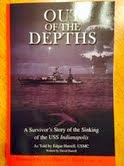
The book written by David Harrell, as told by Edgar Harrell.

This was an extremely powerful talk last Thursday. It is one I keep thinking of and pondering over. It is amazing that these 317 men survived. They lived through a nightmare, somehow finding the courage and strength to do so. Edgar's son, David, wrote a book about it that gives more details than could be covered during the talk. I'm looking forward to reading it and finding out more of the story. So on this Veteran's Day, I've been thinking of the USS Indianapolis crew. True heroes. It is impossible to put into words the thanks for your sacrifice.


Thursday, September 26, 2013

My Weird Life

This morning after running a few errands, I decided to quickly run into the Genealogy Room at the Williamson County Library here in Franklin, Tennessee. I just needed to do a quick look up in an index for a reference to a marriage record. Then I noticed a couple books on Marshall and Lincoln counties. These two counties are adjacent to each other in Tennessee.

I have a Whitsett and Bigger/Biggar connection I've been trying to figure out. They created records in both counties, as most of my other ancestors in this area did. This is due to county boundary changes, families marrying into each other, business transactions, and just plain county line hopping.

Anyway, James Whitsett married Mary Bigger. Joseph Bigger is Mary's father. James dies and leaves behind a wife and minor children. Then Alexander Bigger becomes the guardian for said minor children. Makes sense right? Keep it all in the family. However, what I really want to know is, who are the parents of Joseph Bigger? So I'm perusing the book with court record abstracts. I'm finding all sorts of references to Joseph, his brothers, and Alexander. Then I find the will of Sarah Bigger.

Sarah Bigger's will was filed in Lincoln County or at least a copy of it was. The first line reads, "I, Sarah Bigger of Williamson County, Tennessee..." Wait. What?!? Williamson County? I live in Williamson County! I look up and around the room I'm sitting in. Is this a joke? Is there a hidden camera somewhere? I have to reread that line 3 times for it to sink in. Next I grab a marriage index book for Williamson County. Sure enough, Joseph and his brothers are listed. This is crazy. What are the odds of me living in the same county where I had ancestors living at one time?

Sometimes, even for me, my life is just too weird.

Tuesday, September 24, 2013

The British Institute

If you are looking for a genealogy education opportunity this October, then the British Institute might be just the thing you are looking for. Want some more information? You're in luck, one of the organizers of the institute asked if I could post the following announcement.


Don’t Miss Your Opportunity to Study With The Experts!

If you’re a last-minute Lilly (or Louie), there is still time to register for the few remaining open spots to attend the British Institute in Salt Lake City, 7-11 October 2013.

The International Society for British Genealogy and Family History will accept registrations until Monday, 30 September, for a week of lectures and mentoring by well-known British genealogists Graham Walter, Maggie Loughran and Paul Blake.

The registration fee is $495, and covers five days of instruction with morning lectures and afternoon research opportunities in the Family History Library, including one-on-one mentoring with your instructor.

All courses will be in the Radisson Hotel Downtown, a short walk to the Family History Library. Hotel rooms are still available at the Crystal Inn at $79.00 per night, including breakfast and shuttle bus service to and from the airport, and to the Radisson each day.

Full details and registration at <www.isbgfh.org>

 Using the Cloud for British Family History Research
Graham Walter

Graham Walter combines his IT background with his expansive knowledge of British genealogy resources. This course will provide a guide as to what “The Cloud” is and how we can use it to our advantage in our research.

There are a number of Internet sites that provide some unique datasets for researching British ancestors. We will examine some of these sites and look at the varied search techniques that can be used to find those elusive ancestors hiding in the nooks and crannies of their databases.

The Cloud also provides us with a wealth of tools to enhance the way we collect, share and present our data. We will look at how these services allow us to choose a variety and combination of computing devices that best suits the collecting of our family history on any research trip. The Cloud will allow us to move that data to our other devices seamlessly and without complexity, as well as share it with our families and other researchers. Students in this course must provide their own WiFi-capable laptop computer.

 Course Outline:
Monday
  • ·      Introduction/Overview
  • ·     What do we mean when we say "The Cloud?"
  • ·      Notepads/Journals(Evernote/SpringPad/NoteSync/SimpleNote)
  • ·      Website of the Day - findmypast.co.uk
  • ·      Research Journalling with Evernote
      Tuesday

  • ·      Cloud File Storage(DropBox/SkyDrive/Google Drive/Amazon Cloud Drive)
  • ·      Cloud Backup (Carbonite/Mozy)
  • ·      Website of the Day - thegenealogist.co.uk
  • ·      Research Data Storage and Family History Programs

Wednesday
  • ·      Office applications in the Cloud(Google Docs/MS Office Web Apps/Zoho Suite)
  • ·      Website of the Day - Ancestry.co.uk
  • ·      Data extraction and manipulation with web

Thursday
  • ·      Task Management (Remember the Milk/Astrid/Toodledo)
  • ·      Websites of the Day - Online Newspapers britishnewspaperarchive.co.uk,
  • ·      Welsh Newspapers Online
  • ·      Using Mobile devices in Research

Friday
  • ·      Collaboration in the Cloud
  • ·      Photo Storage and Sharing(Flickr/1000 Memories/Picasa)
  • ·      Cloud Mapping the Ancestors(Google Maps/Bing Maps)


 Sources For Tracing Pre-mid-nineteenth
Century English Ancestors
Maggie Loughran and Paul Blake

This course will concentrate on tracing pre-mid-nineteenth century English ancestors and will be of special interest to those whose ancestors emigrated to North America prior to the
commencement of English civil registration in 1837, or those who have already tracked their ancestors back to the early 1800s.
Paul and Maggie will focus on the actual records themselves, giving you an in-depth understanding of them. For each record category we will be looking at examples of the original documents and guide you through how to interpret, locate and, lastly, how to access them using the Internet and any other available resources.

Record Categories
Locating, interpreting, and accessing pre-1858 English probate records
From the 13th century until the civil probate system was introduced in 1858, probate (the ratification of a will) was controlled by the church. Wills were recorded in the
ecclesiastical archives as were most matters to do with death, with over 300 church courts functioning at one time or another. These jurisdictions frequently overlapped each other and
boundaries may have changed from time to time making the use of early wills and other probate records challenging to say the least. This session will take you through the process of
discovering if your ancestor left a will and where to find it plus any other associated probate records including administrations, inventories and accounts.
plus much more…see the website for complete details

www.isbgfh.org

Friday, September 20, 2013

Discovery of a Group Migration of Convenanters

Ideally when setting out for a day of research you have one or two questions about a particular person to focus on and drive your research for the day. Maybe you will come across an item that will lead you to an unexpected source to investigate about that person. Generally it doesn't require that you bring a binder full of ancestors, or your genealogical software with all your kith and kin mapped out. For me, this is mostly true...unless it involves the adjacent Marshall and Lincoln counties in Tennessee.

A few weeks ago I went down to the local library in Lincoln County, Tennessee which you can read about here. For this research I have to bring my "cheat sheets." These are just pedigree charts with a few notations on them. Some of these notations include what dates/locations I have proof for, what I suspect or have a question about, brief military information, and possible connections. These are my working notes in short hand, if you will. I would never show anybody these, they are for my eyes only. I need these notes for researching in this area. This is a very rural community and I have a lot of ancestors here that criss crossed over county lines, married, and conducted business with each other. So while I may focus on one person, all of my other kin can't help showing up in the records that I'm looking at. I need my cheat sheets to keep track of them all.

So there I was sitting in the library looking at a couple of sources, making notes, checking my cheat sheets occasionally and I notice something. There were a lot of people that came from South Carolina to Lincoln County, Tennessee. Why? Why would all these people come here of all places? I mention this observation to the library volunteer. To which she says, "Oh, maybe they were Covenanters."

I don't know what a Covenanter is. She didn't really either, other than they had something to do with the Reformed Presbyterian Church. Hhmmm. So when I get home I Google it. I click on the Wikipedia site and discover that it has to do with a Scottish Presbyterian movement that started in the 1500's. In a nutshell, they were groups of people, or covenants, that were committed to upholding the ideals of the Presbyterian religion. After 150+ years of all sorts of political trouble, they flee to Ireland. Then around 1717 a group of Covenanters decide to leave Ireland and migrate to North America, settling in the Philadelphia area with one group forming the Reformed Presbyterian Church . Not surprisingly, Covenanters would become avid supporters for independence from Great Britain. They would also volunteer in large numbers to participate in the Revolutionary War. Later, around 1800, this group would oppose slavery and outlaw slave-holding for the people within the congregation.

This is all great, but what does it have to do with my people coming from somewhere in South Carolina? I Google some more and find Reverend William Martin. He came to Rocky Creek, Chester County, South Carolina with a huge congregation during 1772 in 5 ships. Over time it seems little groups would splinter off and migrate elsewhere in the U.S. One of these little groups would migrate to Lincoln County, Tennessee.

After I learn this I look back at my cheat sheets. There are several people who were born in Ireland and died in Chester County, SC, a couple more who were born there, and one with this note "Rocky Creek?, SC." All of these people were members of the same church. This was a group migration from Rocky Creek, Chester County, South Carolina that followed the preacher. I sit back to let this sink in.

These people knew each other in South Carolina. I look at the dates in my notes. Gasp! They probably knew each other in Ireland! This is immediately followed by the next thought of; I wonder if they knew each other in Scotland?? Whoa. I've just gone from researching this group in two counties of one state, to two states and three countries. It's a good day.

Friday, September 6, 2013

Charity, Breakfast, and a Hero

Last May my DAR chapter, Sarah Polk, held their annual silent auction. It helps raise money for our chapter and enables us to then be more philanthropic. One of the items up for auction were seats to the Operation Stand Down breakfast on September 6, 2013. The keynote speaker was scheduled to be Tony Mendez.

Operation Stand Down is an organization that provides assistance to veterans so that they can rejoin society productively. It is a really good cause and an important one. Our veterans deserve this help to readjust to the society we live in, after experiencing whatever horrors they have had to face. I was happy to bid on a seat. Plus there was breakfast and I like food so it had that going for it too.

Now the other attraction was Tony Mendez. Last year there was a film that came out called, "Argo." This was by far my favorite film of the year. It centers on the 1979 hostage crisis in Tehran. I vividly remember this crisis as a kid. I remember the news footage of hostages with hoods on their heads, the failed helicopter rescue, the start of tying yellow ribbons around trees, and just the absolute horror of American civilian hostages that went on and on and on. One group of hostages was held for over 400 days. Then there were the 6 that got away...with a little help.

Tony Mendez is the hero of this story. He devised a plan to extract the 6 Americans that escaped from the embassy. The film follows the crazy plan, the anxiety, the fear, and the danger. The very real, terrifying danger. Tony put his life in peril to save these people. In the U.S. Tony was a guy in charge. He could have sent somebody else to do it, but he didn't. In short Tony Mendez is a hero. That is one reason I was so excited to meet him. The other reason? To me, Tony also represents all the men and women who do things for this country that we will never know about unless a book is written, or a movie is made about them. Tony represents the unsung heroes of our country.

The keynote address at the breakfast was a strange mock interview set up with Tony and his wife, that was intercut with many clips from the movie. In short, it was a little odd. Tony really didn't say much and his wife did most of the talking. I felt like there was something else going on that the audience wasn't privy to. Based on my own observations, I wondered if perhaps Tony is a shadow of his former self. At times I wasn't sure how cognizant he was.

At any rate after the keynote address was over, Tony and his wife sat at a table to sign his book. Of course, I had to get one and see if I could get my photo with him.


I was beyond thrilled. A charitable contribution to a wonderful cause, breakfast, an interesting (strange?) keynote address, a signed authored book by a hero, and a photo with said hero. It was a fantastic morning!

Saturday, August 31, 2013

More Adventure Than Anticipated

It's Labor Day weekend here in the U. S. There are lots of festivities, observances, and of course sales going on. So when my husband informed me yesterday that he was going to take our boys canoeing and camping today, I saw it as an opportunity. For a day filled with shopping you ask? Oh no no dear reader. I went down to Lincoln County, Tennessee in search of ancestors and answers.

Lincoln County sits right at the border of Alabama in Tennessee. It is very rural by today's standards. It's hard to imagine what it must have been like when my ancestors lived there. Fayetteville is a sleepy little town in Lincoln County where the cars still park on a diagonal around the town square. It isn't difficult to imagine how it must have looked 50 years ago. By the time I arrived it was a little before lunch time and I was slightly hungry. However, I was also eager to look at what I had come for so I decided to eat later. This would prove to be a mistake.

My first stop was in Fayetteville-Lincoln County Library. I was pleasantly surprised by the library. It has two floors with a genealogy room on the second floor. I walked into the Genealogy Room and was greeted by the volunteer, who asked what I was looking for.  She helped me locate the book I had come for (about the Jobe's), and then we got to talking. She gave me a bunch of oral history on the current Jobe's that live in the area, and showed me on a current map where the old Jobe place used to be and warned me about a speed trap in the area. I also got the numbers of "the two Jobe boys" who still live in the area. Based on census records and deeds I suspected my Jobe ancestors must have lived very near where Lincoln, Marshall, and Bedford counties meet. After looking at the map I discovered I was correct.

The unexpected find today was a book on the Luttrell's. My Luttrell line is out of Knoxville, so it wasn't on my radar to look for them in Fayetteville at all. Even better, this book was published in April 2013! The author had included her email, Facebook name, and her website on the back of the title page. Yes!! It even had a few interesting citations in it too. At this point I realize time is getting away from me. It's 4 o'clock and the Civic Center and Museum closes at 4:30. So I grab my copies and get to the Civic Center by 4:08. It's closed for the day. Grrr. I also realize that I never had lunch, I'm hungry, and there are no restaurants open. Maybe I'll find something on the way out of town.

Out of town turns into country just about immediately. I'm going a different way out than how I came in. I want to go to a cemetery and see that house the volunteer was telling me about. As I am traveling along this rural road I make a cool discovery:


I'm curious about what is down the road but I have a cemetery and a house to find. Plus I'm still hungry. After driving down a couple winding country roads and minding my speed for the warned speed trap, I find the Talley Cemetery.


You know you have done a lot of research in an area when you recognize surnames on mailboxes while you are driving along. Anyway, as I pull in there are a few things that occur to me at once. It has just rained lightly which will make for a wet tromp through the cemetery, and I could use a restroom. Classic. I'm also getting hungrier. These concerns are soon replaced by my concern over possible snakes, ticks, and chiggers. The cemetery is surrounded by pastures and I soon realize... cows.

At any rate, there are a few people I'm looking for at the cemetery. They are already on Find A Grave, but I want to see where they are in the cemetery, who they are placed with, and who else is around them. In particular I'm interested in Jane Jobe. Her gravestone on Find A Grave doesn't look old and I want to check it out in person. Then I find her.


Well, crud. Her stone looks newer than I thought it would. I start to think about how I can find the paperwork for this stone. I plead with her to help me find some answers to a particular problem. I realize I'm talking out loud. The cows ignore me. Meanwhile, I wander around the cemetery taking photos for Find A Grave requests and finding my ancestors. By the time I'm done, I'm dripping with sweat in the 90 degree humid heat. My legs feel itchy from the bugs. I'm ready to find the old home the volunteer told me about. So off I go and then suddenly there it is:


And it's for sale:


As I get out of my car to take these photos, some guy in a bright red pick up honks at me. Great. I vaguely wonder if he has a sandwich. I'm really hungry now. I haven't eaten since breakfast. As I tromp through the front yard I worry about snakes and ticks. This place appears abandoned. I turn to make my way back to the car and walk through a massive spider web. Now I'm doing that "I just walked through a spider web dance" on the front lawn of this 1858 Antebellum home. You know the dance..... it's where you're sort of jogging, turning in circles, and waving your arms all around over your head. My list of worries now includes; snakes, ticks, spiders, and an imminent arrival of the sherif to investigate the crazy woman on the front lawn of the old house for sale. For the next couple of hours I will be finding and picking off cob web from my person. Oh joy.

Time to find food. I'm driving.... and driving.... still driving. While driving I'm passing a lot of cafes and restaurants. So what's the problem? They are all abandoned and the properties are for sale. I pass a place called, Coon Den Lodge. What?? I'm too hungry to turn around and investigate, plus I still need a  ladies room. 

After what seems like forever, I get to the highway and to a restaurant. I'm too hungry to go home and make something. I must look a site. The whole drive I've been raking my hands through my hair to get off stray webs and I'm paranoid that every skin tickle is a spider, tick or chigger. When I sit down and order, I give a whole new meaning to inhaling food. I think I scared the waiter. I don't care, I'm just that hungry and I've had an ordeal. If I weren't so food deprived I'd order a drink, instead I order dessert to go. Now that I've eaten I just want a shower.

Overall I discovered quite a bit today. I still need to evaluate it all. Some things I learned? Next time pack boots and snacks.

Tuesday, August 27, 2013

FGS 2013- A Recap

I admit it, I wasn't very diligent about blogging this trip. I'm sorry. The Allen County Public Library was a huge distraction and staying at a hotel farther away from the conference center was an added obstacle. By the time I made it back to my hotel in the late evening, after being gone since the early morning hours, I was exhausted. So I'll give you a rundown of the sessions I did attend.

Thursday marked the opening of the exhibit hall, which is always cause for a lot of excitement. I had a few things in mind to purchase this trip. My first purchase was a magazine from the publishers of Family Chronicle titled, Tracing Your War of 1812 Ancestors. It has a good overview of events and gives suggestions of others sources to read.

The first session I attended was Craig Scott's Records of Forts and Posts. This was a very good session. Craig as always is extremely knowledgable about military record groups at NARA. It's amazing he can keep track of them all! I learned that their were two kinds of people in forts; people who ran the fort and the regiment in the fort. I had never thought about it in this way, but it makes sense. Regiments move around, somebody has to stay at the fort and maintain it. Craig went on to discuss textual records, search strategies, finding a post, and information that would be found on various records.

Next, I attended Elizabeth Kelley Kerstens session on Finding a Needle in the Haystack of Territorial Papers. I learned a little about the Territorial Papers at IGHR at Samford this past summer in the Understanding Land Records class. As you might imagine this record set deals with territorial land purchases. It is an interesting group of records, but there is no guarantee that your ancestor is mentioned in them. However, that doesn't mean that their neighbor, brother, or cousin isn't in them so it doesn't hurt to check it out. Elizabeth also mentioned Record Group 28 that has the Records of the Post Office Department. Somebody had to deliver your ancestor's mail, or maybe it was your ancestor!

The last session I attended for the day was Huguenots in New Amsterdam and Early New York presented by Karen Mauer Green. If ever you want to learn about Huguenots then Karen's lecture would be an excellent choice. Although my Huguenot ancestors did not settle in New York it doesn't matter. The background history is the same and the research methodology can still be applied. Karen gave historical background information and told us that there were two waves of French Huguenots to New York. She also showed us examples of how many variations there could be to one surname in the records. It seemed that this was the result not only of the ancestor but of the person/institution who was creating the record. The possibilities were mind boggling.

Friday and Saturday morning I ended up in the library researching. I had planned to attend a couple of sessions during that time, but I was lucky enough to find a truckload of information about my ancestors. Although I didn't win any prizes or giveaways, I still felt like I won the information jackpot. Saturday afternoon I attended two sessions. The first was, Obtaining the 20th Century Military Records From the National Records Center by Patricia Wall Stamm. I have a WWI veteran and I would like to order his file from the Records Center. Patricia did a good job of explaining the history of it, the fire that consumed the old location, the procedures of the new location, and what records are available. I always hear people complain about the length of time it takes to get records from this repository, and I was aware that they get a lot of requests. However, I didn't realize that the Records Center receives somewhere between 5,000-6,000 requests per day. Per day. How crazy is that? Now wonder it takes them a while. Not only that, priority is given to urgent requests that come in. For example, a veteran who is still living and needs his records for hospice assistance, etc.

The very last session I attended was another of Craig Scott's on The Indian Wars. He told us there were four periods of Native American conflict, and reviewed the conflicts that fell into those time periods. Again, many record groups were discussed and what you would find in them. He referred us to the Mitchell Map on Google. I love maps so I was pretty excited about that mention. There are so many records for this particular subject it is dizzying. Needless to say, if your ancestor took part in any Indian War, then you have a lot to work with even if your ancestor is not mentioned directly.

Other conference news that you have probably heard about by now is that a new version of Family Tree Maker will be released in September, the next FGS conference will be held in San Antonio, and the one after that will be held with RootsTech in Salt Lake City. During the conference there was a big push to raise money for Preserve the Pensions of 1812. The money raised will be used to scan these documents and put them online at Fold3. There were a few companies that pledged to match the money raised at the conference and this all added up close to 1 million dollars in all, with the matches included. Pretty impressive.

I had a great time and met some interesting people. It is always fun to see your friends, talk shop, get ideas, ask for advice, and hash out a problem or two. For a week you get to live in a genealogy bubble, and it's pretty amazing.